The interview ended at 4:40 on a Tuesday. The HR person smiled, said "Thank you, we'll get back to you by Friday," and left the call.
It's now the following Wednesday.
You've checked your spam folder more times than you'd admit. Your phone stays on loud, even in the bathroom. Every unknown number makes your heart jump, and every time it's a credit card offer. At dinner someone asks, "Result aaya?" and you say "Process chal raha hai," which is true, as far as you know.
The strange part is that it went well. You answered every question. The interviewer laughed at the right places. The call ran fifteen minutes over. So why has nobody called?
The short answer: silence after a good interview usually means the decision isn't final yet, or that you aren't their first choice yet. Hiring involves more people and more waiting than a candidate ever sees, and many companies never send a rejection at all. Give them the time they mentioned, follow up once or twice, politely, and keep applying until you have an offer letter in hand.
No response after an interview is more common than you think
If it feels like this happens to everyone, the data agrees. In Greenhouse's 2024 State of Job Hunting report, 61% of job seekers surveyed in the US, UK and Germany said they had been ghosted after a job interview.
There's little reliable large-scale data on this for India. But spend ten minutes on any Indian job-seeker forum and you'll read the same story again and again: four rounds cleared, "you'll hear from us soon," then nothing.
So the silence isn't a special verdict on you. It's how a lot of hiring works right now. That doesn't make it fair, but it does mean you should stop reading meaning into every day that passes.
From the HR side of the desk: what happens after you leave the room
Most candidates picture the interviewer walking out and deciding. In most companies, it doesn't work that way. The person who interviewed you rarely decides alone, and is usually not the person who tells you the result.
Here's the path your profile usually takes after the call ends.
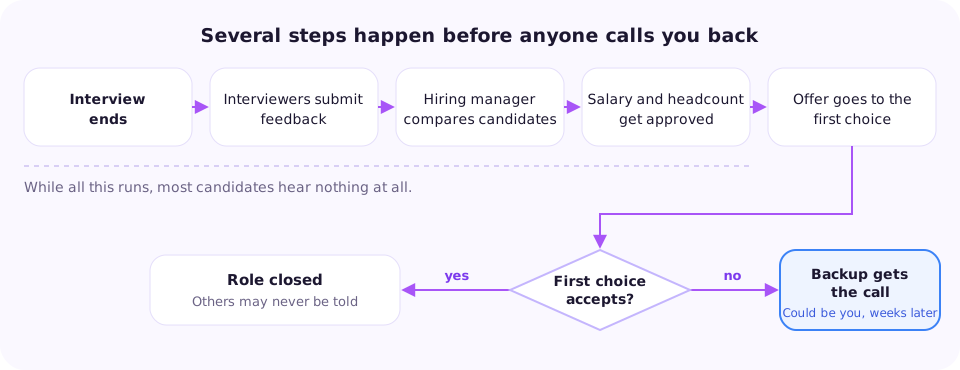
Every step is a place where your profile can sit for days. Interviewing isn't the interviewer's main job, so their feedback form often goes in late. The recruiter usually waits until every candidate in that round has been seen. Then salary and headcount need someone senior to sign off.
And here's the part recruiters rarely say out loud. A strong second choice is valuable. If the first choice negotiates hard, takes a counter-offer from their current company, or can't serve a shorter notice period, the recruiter needs you still interested. Saying "you're our backup" might lose you. Saying "no" too early might lose the role. So many recruiters say nothing at all, and keep their other options warm until the top candidate signs.
It isn't kind, and it isn't how good HR teams should work. But knowing it changes how you read the silence. Nobody calling you on day four rarely means "rejected." It often means "not decided" or "not you, unless."
7 reasons recruiters don't call back after a good interview
1. You're their second choice, for now
The offer has gone to someone else, and the company is waiting for that person to say yes. If they accept, you may never hear back. If they back out, you might get a call two or three weeks later, as if no time had passed. It's also the reason you're least likely to ever be told about.
2. The decision is waiting on someone else
One interviewer liked you. Another hasn't filled the feedback form. The hiring manager is travelling, or wants to see one more candidate before deciding. Until the people involved agree, the recruiter has nothing definite to tell you, so they tell you nothing.
3. Salary, notice period or joining date got in the way
This is a very Indian reason, and it's often the real one. Near the end of the interview, they ask your current CTC, expected CTC and notice period. Your answers may have been completely honest and still not fit.
Maybe the role's budget tops out below your expectation. Maybe you're serving a 90-day notice period and they need someone within 30. Maybe the job needs you to relocate, or work shifts you hesitated about. Your answers to the technical questions may have been perfect; these three numbers can still decide the outcome. If salary is the sticking point, our expert answer on negotiating your first salary offer is worth reading.
4. Someone else matched the job more closely
You can do well and still not be picked. Another candidate may have used the exact tool the team needs, had an internship in the same domain, or come through an employee referral. Hiring compares people against one job's needs. It isn't a ranking of who is better overall.
5. The role was frozen, changed or reposted
Budgets get cut mid-hiring. Teams get restructured. Sometimes the role is rewritten after interviews show the company what it actually needs. If you see the same job reposted on Naukri or LinkedIn, it doesn't automatically mean you were rejected, or that you're still in the running. Ask the recruiter directly whether the process is still on.
6. It felt good to you, but wasn't strong enough for them
This one is uncomfortable, but worth checking honestly. A friendly interviewer is not the same as a convinced one. Many interviewers are warm with every candidate.
Look back at the interview. Did you explain your own project in depth, including what went wrong and how you fixed it? Did you give specific examples, or general answers anyone could give? Did you ask them anything about the role? If you're not sure, our experts have answered how to present your projects and skills in interviews.
7. Nobody bothered to send the rejection
Sometimes the decision is made and you're simply never told. Greenhouse's data showed that in the second quarter of 2024, only 4% of the roughly 6,500 companies using its hiring software contacted every rejected applicant (Axios). A recruiter closes the job in the system, the rejection emails never go out, and you're left waiting for a call that was never coming. That's poor practice on their side, not a reflection of you.
"It went well": what interview signs actually tell you
After an interview, most of us replay it looking for signs. Here's what the usual ones really tell you, from the side of the people who hire.
| What happened | What you think it means | What it usually means |
|---|---|---|
| The interview ran over time | They loved me | The conversation flowed, or the interviewer had a free slot. Not a decision. |
| They told you about the team, office and perks | They're selling the job to me | Many interviewers do this with every candidate. |
| They asked your notice period and expected CTC | An offer is coming | A standard question for anyone still in the running. A real negotiation on the numbers is a stronger sign. |
| They said "We'll get back to you" | Either yes, or a polite no | A closing line. It tells you nothing either way. |
| HR asked for payslips, your last offer letter or ID documents | The offer is nearly here | One of the stronger signs, but still not an offer. |
| The interviewer connected with you on LinkedIn | They want me on the team | Usually just courtesy. |
The only sign that truly counts is an offer letter, in writing. Until then, treat every opportunity as open, including this one.
How long does HR take to respond after an interview?
There's no fixed number. Some companies decide in two days; others take a month because of approvals or extra rounds. What matters more is the timeline they gave you. If they gave none, this is a reasonable way to read the wait. The follow-up timing follows Georgetown University's career center guidance on interviewing.
| Time since the interview | What it usually means | What to do |
|---|---|---|
| 1–3 working days | Completely normal. Feedback is still being collected. | Send a short thank-you note on the same day, then nothing. |
| About 1 week, or the date they gave has passed | The decision is pending, or other candidates are still being seen. | Send one polite follow-up. |
| About 2 weeks | Approvals are stuck, or you may be the backup. | Send a second, final follow-up. Keep interviewing elsewhere. |
| 3–4 weeks | They've likely moved on, or the role is on hold. | Stop following up. Treat it as closed unless they contact you. |
| More than a month | Rarely revived, though it happens when the first choice drops out. | If they come back, respond warmly and decide on fresh terms. |
Campus drives run on their own timeline, which we cover further down.
How to follow up after an interview (with messages you can copy)
Before you leave: ask for the timeline
The best follow-up starts in the interview itself. In the last two minutes, ask:
"Thank you for your time. Could you tell me what the next steps are, and roughly when I should expect an update?"
Now you have a date to work with instead of a guess. If they say "in a week or two," that's fine. You know when to follow up.
Pick the right channel
Use the channel the recruiter has already used with you. Many Indian HR teams coordinate interviews on WhatsApp, so if they messaged you there, following up there is normal. If everything so far was on email, stay on email. Call only if they called you before and said you could.
Same day: a short thank-you
Subject: Thank you – [Job Title] interview
Dear [Name], thank you for speaking with me today about the [Job Title] role. I enjoyed learning about [one specific thing they told you], and I'm keen to be part of it. Please let me know if you need anything else from me.
Regards, [Your Name]
After a week: the follow-up email
Subject: Follow-up on [Job Title] interview on [date]
Dear [Name],
I interviewed for the [Job Title] role on [date] and wanted to check whether there's an update on the next steps. I'm still very interested in the position.
Happy to share anything else that would help.
Regards, [Your Name] | [Phone]
On WhatsApp
Hi [Name], this is [Your Name]. I interviewed for the [Job Title] role on [date]. Just checking if there's any update on the next steps. Still very interested. Thank you!
If you have another offer with a deadline
This is the one situation where it's fine to nudge harder, as long as it's true.
Hi [Name], I wanted to keep you informed: I've received another offer and need to respond by [date]. [Company] is my first preference, so I wanted to check where things stand before I decide. Thank you for understanding.
Never invent an offer to speed things up. HR people talk to each other more than you'd expect, and it's easy to get caught.
The final message (about 2 weeks later)
Hi [Name], following up one last time on the [Job Title] role. I understand if the position has moved forward. If so, I'd be grateful to be considered for similar roles in future. Thank you for the opportunity.
This closes the loop politely and keeps the door open. Recruiters do remember candidates who handled silence gracefully.
What not to do while you wait
Waiting makes all of us do strange things. These are the ones that quietly hurt your chances.
- Calling every day. One follow-up after a week is professional. Daily calls make a recruiter dread your name.
- Long, emotional messages. "I really need this job, my family is depending on me" is honest, but it puts the recruiter in an awkward spot and doesn't change the decision.
- Messaging everyone on the panel. Don't DM each interviewer on LinkedIn or find the hiring manager's personal number. Stick to the person coordinating your process.
- Saying you've turned down other offers. If it's not true, it can backfire badly. If it is true, it's still not their problem.
- Posting about the company while you're still in the process. An angry LinkedIn post can travel further than you think.
- Paying anyone to "speed up" your result. Genuine companies never charge for interviews, results or offer letters. Scams aimed at job seekers are common: in an Indeed survey of 1,161 people in India, 93% said they had come across suspected recruitment scams (Madhyamam).
- Pausing your job search. This is the big one. Until an offer letter is signed, this job doesn't exist yet.
Waiting for a campus placement result? It works differently
In a campus drive, the company usually sends the final list to your college's placement cell, not to you. So the silence has extra layers. The company may be finishing drives at other colleges before deciding. The list may be waiting for approval internally. Or the placement cell may have received it and is waiting for the official mail before announcing.
A few things help here:
- Ask your placement cell, not the company. Your student coordinator or the TPO is the right person. Messaging the company's HR directly, unless they told you to, can annoy both sides.
- Ask once, as a group if you can. One message from the class coordinator gets a better answer than forty separate ones.
- Know your college's offer policy. Some colleges don't let you sit for another drive once you're selected. Find out the rule before you skip the next company while waiting for this one.
If you work in a placement cell, this is one of the problems we wrote about in the 7 problems TPOs face in campus placement management.
What to do while you wait
The wait is wasted only if you spend it refreshing your inbox. Use it instead.
- Write down every question you were asked, within an hour. Memory fades fast. Mark the ones where you hesitated or gave a vague answer. This list is your best preparation for the next interview.
- Keep applying and interviewing. Two or three live processes take the pressure off any single one. It also puts you in a better position to negotiate if an offer does come.
- Prepare for the questions your resume will trigger. Most interview questions come straight from your resume: your projects, your internship, the skills you listed. BluffHR Resume Intelligence builds interview questions from your own resume, so you can practise the exact ones you're likely to face.
- Check whether you're getting enough interviews in the first place. If interviews themselves are rare for you, start with our guide on why you're not getting interview calls.
If the answer is no
A rejection, even a late one, is better than silence. When it comes:
- Reply anyway. Thank them, say you'd like to be considered for future roles, and keep it to three lines.
- Ask for one piece of feedback. "If there's one thing I could improve for future interviews, I'd really value hearing it." Many companies won't answer, often for policy reasons. Don't take that personally.
- Don't turn one decision into a verdict on yourself. You were compared against one role's needs, on one day, with candidates you never met.
And if no answer ever comes, accept that you may never know why. Close it in your head, and give your energy to the next one.
Frequently asked questions
Does no response after an interview mean I'm rejected?
Not necessarily. It often means the decision is still pending, approvals are stuck, or you're the backup while the first choice decides. After three to four weeks with no reply to your follow-ups, though, it's safest to treat it as closed.
How long should I wait before following up after an interview?
If they gave you a date, wait until it passes, then follow up a few days later. If they gave none, follow up about a week after the interview, and once more around two weeks.
How many times should I follow up?
Twice is enough: once after a week, and a final message around two weeks. After that, more messages rarely help.
Is it okay to follow up with HR on WhatsApp?
Yes, if the recruiter has already contacted you on WhatsApp. Keep it short, mention the role and interview date, and send it during working hours.
Should I call HR instead of emailing?
Only if they called you earlier and said you could. A call puts the recruiter on the spot when they may not have an answer yet. A message lets them reply when they do.
What should I do if I get another offer while waiting?
Tell the company you prefer, honestly and politely, and give them your deadline. It often speeds up a stuck decision. Never make up an offer to create pressure.
Can I ask why I wasn't selected?
Yes, politely and once. Many companies won't share detailed feedback, but some will give you one useful line.
One silent recruiter doesn't decide your career
If this is your first job hunt, every interview feels huge. You prepared for days. You told your family it went well. You've already imagined the offer letter.
When the call doesn't come, it's easy to decide that you weren't good enough. But a slow reply isn't proof you did badly, and a good interview was never a promise. Both can be true at once. Most of what happens after you leave the room, you'll never see.
What you can control is small and practical: ask for the timeline, follow up twice, keep applying, and walk into the next interview better prepared than the last.
You deserve clear communication from employers. You also deserve not to let their silence decide how you see yourself.
Start today. Write down the questions from your last interview while you still remember them. Then send one more application. And if you want to know which questions your resume is likely to raise, practise them with BluffHR. Have a situation that doesn't fit any of this? Ask our industry experts. People who hire for a living answer, for free.
Sources
- Greenhouse, Ghosting, ghost jobs and bots: Greenhouse 2024 State of Job Hunting report (2024); also reported by UNLEASH (December 2024)
- Axios, How Greenhouse is taking on job ghosting (September 2024)
- Georgetown University Career Center, Interviewing guide
- Madhyamam, 93% of Indian job seekers encounter recruitment scams, Indeed survey finds (July 2026)