Naukri, LinkedIn, Indeed, a few company career pages, a link someone forwarded in a WhatsApp group. You've applied everywhere. What came back was a few automated "Thank you for applying" emails and a lot of silence.
For a fresher, that silence is loud. Batchmates are posting offer letters. Relatives ask "kuch hua?" at every family function. And somewhere around application number sixty, you start to wonder whether the problem is your degree, your college, or you.
In most cases it's none of those. The problem usually sits in the gap between the moment you click "Apply" and the moment a recruiter decides who gets a call. That gap is what this article is about: what goes on inside it, how to work out where your own applications are failing, and a 7-day plan to change what you send out.
The short answer: most people who aren't getting interview calls are sending one generic resume to jobs that only half fit them, often days after the shortlist has started. The fix is fewer, better-matched applications: a resume that uses the job description's own words, sent early, to roles you clearly qualify for, with a message to a real person for the ones you want most.
Why 100 applications don't mean 100 chances
More applications should mean more calls. That's the logic most of us start with, and it's why applying feels like buying lottery tickets.
But hiring doesn't work like a lottery. A popular entry-level opening can collect hundreds of applications within days. (In Enhancv's interviews with US recruiters, entry-level roles drew 400 to 600 in that time.) Nobody reads all of those line by line. Recruiters search, sort and skim, and the few who look most relevant in that first pass get the call.
So if the same resume went out 100 times, you didn't take 100 shots. You took the same weak shot 100 times. Ten well-matched applications will often do more for you than a hundred rushed ones.
Look back at your last hundred and answer three questions:
- How many times did you change your resume for that specific job?
- For how many roles did you actually meet the main requirements?
- How many had been posted in the past week?
If the answer to most of them is "hardly any", you already know where to start.
Why your resume isn't getting shortlisted: 8 common reasons
1. One resume for every job
A Software Developer opening, a Data Analyst role and a Business Analyst post each want different things. A resume that's identical for all three fits none of them well, and recruiters can tell within seconds whether a resume was written for their job or for jobs in general.
2. The job description's words are missing
Recruiters often search applicants using words straight from the job description: tools, skills and job titles. If the JD asks for "SQL", "Power BI" and "Excel" and your resume says "database knowledge" and "visualisation tools", a search may never surface you, even if you can do the work. Use the exact terms wherever they're true for you.
3. Projects that don't say what you did
Most fresher resumes describe each project in one vague line. Here's a made-up example of the difference.
Weak: "Made a project on an e-commerce website using MERN stack."
Stronger: "Built an e-commerce site with MongoDB, Express, React and Node.js, with login, a cart and a test payment flow; deployed it online, code on GitHub."
The second version tells a recruiter what you built, which tools you used, and that it actually works.
4. Missing a must-have requirement
Some requirements act as hard filters: a particular degree, a minimum percentage, a certification, a language. If the JD says "B.Com with Tally" and you have neither, no amount of rewording will fix it. Put your energy into roles where you meet most of the must-haves.
5. Aiming too high, or too wide
Freshers applying for "Senior Analyst, 3–5 years" is common. So is applying for sales, coding, HR and content roles on the same day because each one said "freshers welcome". Both waste time. Your applications should show a pattern: one or two kinds of role you can clearly argue for.
6. Applying late
Many recruiters start shortlisting as soon as applications arrive, so a job posted three weeks ago may already have its shortlist. Fresh postings give you the best odds. Check your job alerts daily instead of applying in one big batch on Sunday.
7. Filters you didn't know about
Location, expected salary, graduation year, notice period and CGPA cut-offs are often filtered before anyone reads a resume. If your profile says you'll only work in one city, you won't show up in searches for any other. Keep your job portal preferences realistic and up to date.
8. Some jobs were never really open
Not every listing is a live vacancy. In a 2024 ResumeBuilder survey of 1,641 hiring managers, 40% said their company had posted a fake job listing in the past year. There's little reliable data on this for India. Still, if a post has been up for months, is vague about the role or keeps getting reposted, don't spend your best effort on it.
How ATS resume screening actually works (and what's a myth)
An applicant tracking system (ATS) is software that companies use to collect, organise and search job applications. Large employers almost always have one: Jobscan's 2026 analysis found an ATS at 97.4% of Fortune 500 companies. In India, the big IT firms, GCCs and many mid-size companies use one too, and recruiters also search the candidate databases on job portals.
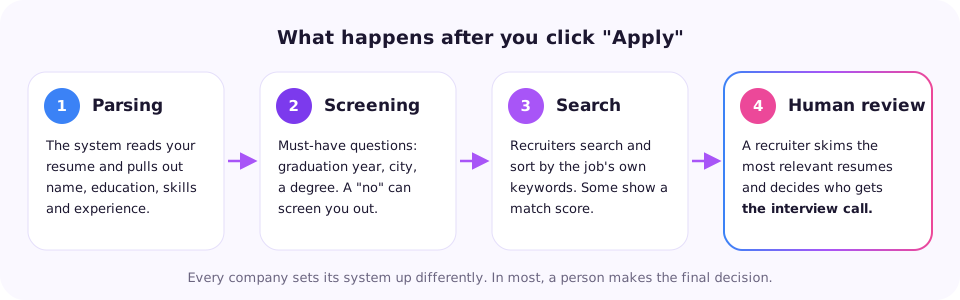
Every company sets its system up differently, but an application usually goes through four steps:
- Parsing. The system pulls your name, education, skills and experience out of your file and into fields.
- Screening questions. Some applications ask about your graduation year, location or a required qualification. A "no" on a must-have can screen you out.
- Search and ranking. Recruiters search or sort applicants by keywords. Some systems also show a match score.
- Human review. A recruiter skims the most relevant resumes and decides who to call.
The "75% of resumes are rejected by bots" myth
You've probably seen this claim on LinkedIn. There's no solid research behind it. When Enhancv interviewed 25 US recruiters, 23 of them (92%) said their system doesn't automatically reject resumes for formatting, design or content such as missing keywords. The filters they did use were mostly eligibility questions: work authorisation, certifications, location.
It's a small sample from one country, and some companies do switch on automatic filters. But the point stands: most of the time, a person makes the decision. Your job isn't to "beat the bot". It's to make sure the system reads your resume correctly, and that the recruiter sees straight away why you fit.
What an ATS-friendly resume looks like
- One column, with no tables, text boxes, skill bars or icons.
- Contact details in the main body, not in the page header or footer.
- Standard headings: Education, Skills, Projects, Internships, Certifications.
- A text-based PDF or .docx, never a scanned image, unless the portal asks for a specific format.
- No hidden keywords in white text. Recruiters can see the parsed text, and it looks like cheating.
We go deeper into this in Can a Bot Reject Your Resume? What AI Resume Screening in India Actually Does.
Is it your resume, your targeting or your interviews?
Don't try to fix everything at once. First find where things are actually breaking. Look back at your last 30 to 50 applications and see which row below sounds most like you.
| What you're seeing | Most likely problem | Fix this first |
|---|---|---|
| Almost no calls, even for roles you clearly fit | Your resume | Tailor it to each JD, rewrite your projects, clean up the format |
| Calls only for roles you don't want | Your targeting and profile keywords | Your job portal headline, skills list and job preferences |
| Calls, but you drop out after the first HR chat | How you present yourself | Your introduction, your salary and location answers, company research |
| You clear online tests but fail technical rounds | Interview preparation | Core subjects, and explaining your own projects clearly |
| "Interview calls" that ask for a fee | The wrong channels | Official career pages and verified job portals only |
Try this now: pick three job descriptions for roles you really want and highlight every skill, tool and qualification they mention. Then open your resume. If most of the highlighted words that are true for you are missing from it, your resume is the first thing to fix.
How to apply for jobs effectively: a step-by-step method
- Pick one or two target roles. For example "Data Analyst" and "MIS Executive", not "anything in IT". That way one master resume does most of the work.
- Build a master resume. Put everything in one long document: every project, internship, certificate, tool and responsibility. You'll cut from it for each application.
- Read the JD like a recruiter. Split it into must-haves (degree, core skills, location) and nice-to-haves (extra tools, certifications). If you're missing more than one or two must-haves, move on.
- Tailor in 15 minutes. Reorder your skills so the JD's come first, adjust your two-line summary, and rewrite two or three project bullets in the JD's words, where they honestly apply.
- Check the match before you send. Put your resume and the JD side by side and look for gaps. A highlighter works. So does BluffHR's Resume Intelligence, which compares your resume with a specific job description and shows your ATS score, job match, missing keywords and red flags, with what to fix first.
- Prioritise your list. Not every job deserves the same effort (see the table below).
- Add a human touch. For roles you really want, find an alum or someone on the team on LinkedIn. A short, specific note beats "Please refer me". For example (a made-up one): "Hi Rahul, I'm a 2026 BCA graduate from your college. I've applied for the Data Analyst role at your company and built two Power BI dashboards that match the JD. Would you be open to a quick look at my resume?"
- Track everything. Keep a simple sheet: company, role, date applied, where you found it, which resume version you sent, and what happened. Within two weeks you'll start to see patterns.
How to prioritise vacancies
| Priority | What it looks like | Effort to give |
|---|---|---|
| Apply first | Posted in the last few days, you meet most must-haves, matches your target role | A fully tailored resume, plus a message to someone at the company |
| Apply if time allows | An older post, or you meet only some of the must-haves | Quick tailoring of your skills and summary |
| Skip | Needs experience you don't have, a vague role, or asks you to pay | None |
Resume tips for freshers in India with no work experience
"No experience" doesn't mean "nothing to show". It means your proof comes from somewhere other than a job.
- Projects are your experience. Pick two or three that match your target role. For each, say what problem it solved, what you built, which tools you used, and where someone can see it: GitHub, a live link or a short report.
- Internships count, even short or unpaid ones. Write what you did and what came of it, not just the company's name and your dates.
- Turn college life into skills. Organising a fest, leading a club or teaching juniors all show real abilities. "Member of the cultural committee" says very little. "Managed registrations for a three-day college fest using Google Forms and Sheets, and coordinated a team of volunteers" says a lot.
- Fewer, more relevant certifications. One certificate backed by a project that uses it is worth more than five on their own.
- Keep education near the top. As a fresher it's one of your strongest sections. Include your CGPA or percentage, because many campus and off-campus drives use cut-offs.
- One page is enough. If yours runs longer, cut the least relevant lines first.
Off-campus placement tips
- Use official channels. Large IT services companies run their own off-campus hiring tests and drives through their official career portals. Apply there, not through links you don't recognise.
- Never pay for a job. No genuine employer charges for a test, an interview or an offer letter. A "registration fee" is a red flag.
- Look beyond the big names. Startups, mid-size companies, GCCs and core roles in your own branch often get fewer applicants per opening.
- Use your alumni network. Seniors from your own college are often the most willing to help. Here's how to get noticed on LinkedIn as a fresher.
- Treat internships as a doorway. A good internship can turn into a full-time offer. If you're struggling to land one, read why internships are so hard to find in India.
Your 7-day action plan
This takes one to two hours a day. It won't guarantee calls within a week, but it will change what you send out, and that's what changes the results.
| Day | What to do | You're done when |
|---|---|---|
| Day 1 | Review your last 30 applications. Mark which ones you fit, when they were posted, and whether you tailored your resume. Choose one or two target roles. | You know your target roles and your weakest habit |
| Day 2 | Collect five recent job descriptions for your target role and list the skills and tools that keep repeating. | You have the 10 to 15 terms that matter most |
| Day 3 | Rebuild your resume: one column, standard headings, and every project rewritten in the weak-to-strong style above. | You have a clean master resume |
| Day 4 | Update your Naukri and LinkedIn headline, skills and job preferences to match your target role. | Your profiles describe the role you want |
| Day 5 | Apply to five recent, well-matched jobs. Tailor each one and check the match before sending. | Five strong applications, sent and logged |
| Day 6 | Message five people: alumni, recruiters or employees at the companies you applied to. | Five short, specific messages sent |
| Day 7 | Review your tracker. Prepare a 60-second introduction and a clear two-minute explanation of your best project. | You're ready for the call when it comes |
After that, keep a steady pace. A few tailored applications a day will usually serve you better than thirty rushed ones. Give it two to three weeks before you judge what's working.
Frequently asked questions
Why am I not getting interview calls even though I'm qualified?
Being qualified and looking qualified on paper are two different things. Usually the resume doesn't clearly match that specific job, the application went in late, or a filter such as location or graduation year screened you out before anyone read it.
How many jobs should a fresher apply to per day?
There's no magic number. A few well-matched, tailored applications a day usually work better than dozens of quick ones. Get the quality right first, then keep a steady pace.
Does ATS automatically reject my resume?
Usually not. Most systems help recruiters store, search and sort applications, and a person makes the final decision. Some companies do set filters for things like qualifications or location, so answer screening questions accurately.
Should I use a two-column or designed resume template?
For online applications, a simple one-column layout is safer. Some systems read columns, tables and graphics in the wrong order, which can scramble your details.
Is it the job market or my resume?
It can be both. The quickest way to tell is to compare your resume with three job descriptions you really want. If key skills you actually have are missing from it, fix the resume first, because that part is in your control.
How long should I wait before changing my approach?
Give a tailored approach two to three weeks. If you're still getting almost no calls for roles you clearly fit, revisit your targeting and your profile keywords.
Should I pay a consultancy to get interview calls?
No. Genuine employers and recruiters don't charge candidates for tests, interviews or offer letters. Treat any such fee as a warning sign.
You're closer than the silence makes it feel
A hundred applications without a reply is exhausting, and it's easy to read that silence as a verdict on you. Usually it isn't one. More often it's a mismatch between what you sent and what the recruiter was searching for, and that's something you can fix.
You don't need a new degree or a famous college name to change your results. You need fewer, sharper applications, a resume that speaks the job's language, and a little help from real people.
Start with one step today. Choose one job you genuinely want, open its description next to your resume, and fix every gap you honestly can. If you'd like a second pair of eyes, check your resume against that job description on BluffHR. Our industry experts have also answered a reader's version of this question: why am I not getting interview calls despite applying to hundreds of jobs as a fresher? And if you have a question about your own situation, ask our industry experts.
Sources
- Jobscan, Fortune 500 use of applicant tracking systems (2026)
- Enhancv, Does ATS reject resumes? Interviews with 25 US recruiters (2025)
- ResumeBuilder, 3 in 10 companies currently have a fake job posting listed (2024)